
There is a story in the Old Testament that says that in the days of King Solomon's reign, there were two women who came before him, each claiming that a particular baby was theirs. Solomon, in response, said that the baby would be cut in half, and half would be given to each. That way, they would both get an equal share. One woman cried out in anguish, "No! Let her have my child! Don't kill him!" Solomon replied that surely this must be the mother, since after all, a mother's love doesn't lie.
Right?
We talked during class about what did and didn't qualify as a mother trying to do what is best for her children. Some people in the class said it would be worse to split the children from their mother. Some said that it ws the right thing to do.
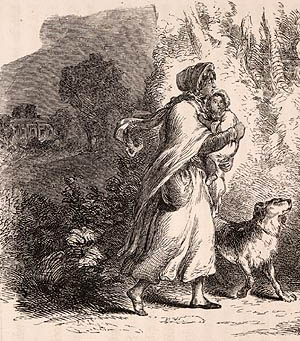
I for one think Jacobs was right. I believe that she knew the horror and degredation her children would suffer at the hands of "Mr. Flint" and she was not willing to take that chance, even if it meant not seeing her children grow up. I do not see her decision as a sign of her poor mothering. I see it as a logical response to a horrendous time.
I see myself with children one day. I love children. As a teacher, this love gets even more intense. I wondered once what I would do to protect my students if, per se, there was a gunman in the building. My answer is simple. I would die for them.
And as a mother, I think that in a way Harriet Jacobs did that for her children. She lost them, and that part of her died in the process.
My mother has told me that I am, literally, a part of her. When she says this, she is using the biological to underscore the emotional. "No one will ever love you like your parents will." She told me once. And I think this applies to Jacobs.
I would give up my child if that gave my child a chance to live. Not just a better life, but a chance to live. Harriet Jacobs children would not have survived Flint's plantation. She was giving them up to let them live.
What does it mean to be a slave and be a woman? Male slaves had it bad enough, but the women had it even worse. Better to be a man, because the women were raped. Just like Harriet Jacobs.
Harriet Jacobs had an overwhelming urge to protect what was hers, when everything else had been taken away. She either gave what was hers away, like her children, so they couldn't be taken from her, or she went to extreme lengths. This was one of the reasons why she took a lover.
"Why does a slave love? Why allow the tendrils of the heart to twine around objects that may at any moment be wrenched away by the hand of violence?" (161). I love her ferocity here. And I love her defiance. The rebel in me revels in it. She risks her life to mouth off to her slave holder. Because her words are hers, and so is her love.
I was enthralled with the passage where she is angry at her Nothern employers for buying her in order to free her from slavery. "So I was sold at last!" (348). How even her moment of freedom cannot be hers. She still has to be bought. And the irony just rankles!
I actually did a whole lesson plan surrounding this passage of Linda's story. It was a two-part lesson, and I tried it out on Jenn's little sister Kaylee, who was an excellent student for me and is a very gifted little girl.
The lesson goes like this:
Gender, Race and Progress
.
Part One
.
Foundational Text: Incidents in the Life of a Slave Girl, Harriet Jacobs
.
Role-Play: I will start with the student by having her imagine that she and her friends are going to the park. I will have her imagine that there is someone at the gate of the park that told her that she could not go in because she has blue eyes. Her friends, who all had brown eyes, could go in, but she couldn’t. She is then told that there is a park down the street that she can go to.
When she gets to the park, there is only a gravel parking lot. How does she feel? What are her thoughts?
.
Draw Comparison to Civil Rights Movement. Discuss.
.
Read section from Incidents in the Life of a Slave Girl. Explain what Linda had to go through to get to freedom. Explain Runaway Slave Act. Explain how Linda was “freed” by her white Northern Employers and how she felt about that.
.
Discuss whether or not Linda is “free”
.
Discuss why she might be upset about the way in which she gained this freedom.
.
Discuss what “freedom” really means. Relate to the freedoms that African Americans fought for during the Civil Rights Movement and why they fought for them.
.
Part Two
.
Where did we come from?
.
Discuss with student where her and my ancestors come from. Locate on map.
.
Discuss how the human race supposedly migrated from
.
Incidents in the Life of a Slave Girl: Remind student of Linda’s desire to be truly free. Discuss how differences in her skin color make that difficult in this time period. Ask student what else might be keeping her from being truly free.
.
Ask student how gender prevented Linda from being free. Give student a synopsis of the control men had over women in 19th century
.
Discuss with student whether it was the same to be a woman and be a slave.
.
Discuss Civil Rights Movement, Women’s Push for the Right to Vote, and Women’s Lib movement
.
Discuss those rights for those groups today.
.
Ask student to create a poster for “a modern women’s rights movement”
At the end of this lesson, Kaylee, Jenn and I talked about how both women and African Americans are still disriminated against today. Kaylee mentioned that a boy in her class stood up and said that he doesn't believe women are equal to men. The teacher let the kids debate it. I was shocked that they let them debate it. But then I had to think about it.
During multicultural lit class for my Education degree, we talked about the Middle Eastern view of women as lesser beings. We discussed that in the classroom, out of respect to other cultures, we shouldn't push the idea that women are equal to men.
.....WHAAAAT?
So, maybe I'm just not getting it, but how on EARTH, is it not okay to teach our children that other races are equal to us, and not teach them that the genders are equal. I have a few words from the bad side of Columbus to say about that, but I'll be a lady and keep them to myself.
As an educator, I have no idea what I'm going to do about this issue. Pray I just end up teaching college for the rest of my life. In that world you can insist that women are equal, right? Or strongly suggest? Where is the line? Should there be one?
Probably. The lines are the only thing that stops us from teaching KKK ideologies. I guess.
Then again, sometimes those seem better accepted than concepts of equality, justice, and respect.
I mean, we women would do anything for our children. We keep trying to be treated as equals. Doesn't that deserve some kudos?
"My master had power and law on his side; I had a determined will. There is might in each," (216).

Good points all around.
ReplyDeleteIn response to the Middle Eastern cultural view: isn't that just more a product of fear than anything else? Would your professor, or whoever asked that it not be brought up, have such an issue with, well, bringing it up, if 2001 hadn't ended so abruptly and violently?
Just something to think about, I guess.
Fear gets us where we live the most, gets to everything we want to say and then shuts it up completely, seals it so as to never come out until we face that fear, or quite frankly, say fuck it, and let it out anyway.
Being a woman (and myself being a man, this is pure speculation) will never be easy. Obviously. But take my mother, as an example: knowing the whole world has tried to marginalize you, to belittle you, to make you into something smaller than you really are...only gives you more power, in the end.
And you know what, only you control the survival of our species.
If that isn't the ultimate hold...what is?
Great blog!
First of all, I love that you used the "Why does a slave love?" quote, that was my absolute fave...
ReplyDeleteAlso, the connections you made to education were great, I, also a future teacher, have encounter may of the same thoughts and feelings when it comes to the topic of not only what you would do for your students/children, but also how it is that we are also supposed to teach them to perceive themselves.
Good moves. Good blog. Liked it.